

What Are Examples Of Primary Consumer Services?
On a sawgrass prairie in the Florida Everglades, an alligator (Alligator mississippiensis) lazes on the banking company of a slow-moving water channel. A great egret (Ardea alba) stalks fish in the shallows. A grasshopper (Brachystola magna) chews on an aster foliage. A raccoon (Procyon lotor) digs in the mud for freshwater mussels. These animals are quite different from one some other and alive in different ways, but they have something in common: In this ecosystem, they are all consumers. Inside every ecosystem, organisms interact to movement energy around in predictable ways. These interactions tin be represented past what scientists call a trophic pyramid. Primary producers—plants, algae, and bacteria—brand upward the base of operations of the pyramid, the first trophic level. Through a process called photosynthesis, producers capture energy from the sun and utilise it to create simple organic molecules, which they apply for nutrient. Consumers constitute the upper trophic levels. Unlike producers, they cannot make their own food. To get energy, they eat plants or other animals, while some eat both. Scientists distinguish betwixt several kinds of consumers. Chief consumers make upwards the 2d trophic level. They are also called herbivores. They eat master producers—plants or algae—and zilch else. For example, a grasshopper living in the Everglades is a chief consumer. Some other examples of chief consumers are white-tailed deer that forage on prairie grasses, and zooplankton that eat microscopic algae in the h2o. Adjacent are the secondary consumers, which eat primary consumers. Secondary consumers are mostly carnivores, from the Latin words pregnant "meat eater." In the Everglades, egrets and alligators are carnivores. They eat simply other animals. Most carnivores, chosen predators, hunt and kill other animals, simply not all carnivores are predators. Some, known as scavengers, feed on animals that are already expressionless. Some consumers feed on live animals only do not kill them. For case, small arachnids called ticks attach themselves to other animals and feed on their blood, merely ticks are not considered predators. They are instead called parasites. Some secondary consumers swallow both plants and animals. They are called omnivores, from the Latin words that hateful "eats everything." A raccoon is an example of an omnivore; it eats plant matter such every bit berries and acorns, but it also catches crayfish, frogs, fish, and other pocket-sized animals. Ecosystems can also take tertiary consumers, carnivores that eat other carnivores. A bald hawkeye is an example of a tertiary consumer you might see virtually the littoral mangrove islands of the Everglades. Its diet includes predatory fish that eat algae-eating fish, every bit well equally snakes that feed on grass-eating marsh rabbits. It is considered a "meridian predator" because no other animals native to the ecosystem hunt or consume it. When a elevation predator dies, it is consumed past scavengers or decomposers. In addition to consumers and the producers that support them, ecosystems have decomposers. These organisms get their nourishment from dead organic material, such as decaying found leaves or expressionless fish that sink to the lesser of a pond.
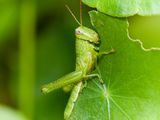
Grasshoppers are main consumers because they swallow plants, which are producers. Producers are the base of the pyramid, the first trophic level.
Photograph by mchin
algae
Plural Substantive
(singular: alga) diverse group of aquatic organisms, the largest of which are seaweeds.
Plural Noun
(singular: bacterium) single-celled organisms constitute in every ecosystem on World.
Noun
organism that eats meat.
consumer
Noun
organism on the food chain that depends on autotrophs (producers) or other consumers for nutrient, nutrition, and energy.
decomposer
Noun
organism that breaks down dead organic material; likewise sometimes referred to as detritivores
Noun
customs and interactions of living and nonliving things in an area.
Everglades
Noun
vast swampy region flowing south of Lake Okeechobee in Florida.
Noun
grouping of organisms linked in social club of the nutrient they eat, from producers to consumers, and from prey, predators, scavengers, and decomposers.
Noun
all related food chains in an ecosystem. Also chosen a food wheel.
Noun
organism that eats mainly plants and other producers.
molecule
Noun
smallest physical unit of a substance, consisting of two or more atoms linked together.
Substantive
organism that eats a variety of organisms, including plants, animals, and fungi.
parasite
Noun
organism that lives and feeds on another organism.
Noun
process by which plants turn h2o, sunlight, and carbon dioxide into water, oxygen, and simple sugars.
predator
Noun
creature that hunts other animals for nutrient.
producer
Substantive
organism on the food chain that can produce its ain energy and nutrients. Also chosen an autotroph.
slough
Noun
marshy wetland largely defined by thick mud.
trophic level
Noun
one of three positions on the food chain: autotrophs (first), herbivores (2nd), and carnivores and omnivores (3rd).

Source: https://www.nationalgeographic.org/encyclopedia/consumers/
Posted by: eppsdiesequan49.blogspot.com
0 Response to "What Are Examples Of Primary Consumer Services?"
Post a Comment