

Que Ã⩠Department Of The Treasury Internal Revenue Service Austin, Texas?
| IRS | |
 | |
| Agency overview | |
|---|---|
| Formed | July one, 1862 (1862-07-01) [1] (though the proper noun originates from 1918) |
| Type | Revenue service |
| Jurisdiction | Federal government of the U.s. |
| Headquarters | Internal Acquirement Service Building 1111 Constitution Ave., NW Washington, D.C. 20224 United States[ii] |
| Employees | 74,454 (FTE) (2019)[3] |
| Annual budget | $11.303 billion (2019)[iv] |
| Bureau executive |
|
| Parent agency | Department of the Treasury |
| Website | www |
The Internal Revenue Service (IRS) is the revenue service for the United states federal government, which is responsible for collecting taxes and administering the Internal Acquirement Code, the main body of the federal statutory taxation law. Information technology is part of the Department of the Treasury and led by the Commissioner of Internal Acquirement, who is appointed to a five-yr term by the President of the United States. The duties of the IRS include providing tax assistance to taxpayers; pursuing and resolving instances of erroneous or fraudulent tax filings; and overseeing various benefits programs, including the Affordable Intendance Act.[5]


IRS Building in Washington D.C.

IRS location sign on Constitution Avenue, Washington, D.C.
The IRS originates from the Commissioner of Internal Revenue, a federal office created in 1862 to appraise the nation's first income tax to fund the American Civil War. The temporary measure provided over a fifth of the Matrimony's state of war expenses before existence immune to expire a decade after. In 1913, the Sixteenth Amendment to the U.S. Constitution was ratified authorizing Congress to impose a tax on income, and the Bureau of Internal Revenue was established. In 1953, the agency was renamed the Internal Revenue Service, and in subsequent decades underwent numerous reforms and reorganizations, most significantly in the 1990s.
Since its institution, the IRS has been responsible for collecting virtually of the revenue needed to fund the federal authorities, admitting while facing periodic controversy and opposition over its methods, constitutionality, and the principle of taxation generally. In recent years the agency has struggled with budget cuts and reduced morale.[half-dozen] Every bit of 2018, it saw a xv per centum reduction in its workforce, including a decline of more than 25 percent of its enforcement staff.[7] Nevertheless, during the 2017 fiscal year, the agency processed more than 245 meg tax returns.
History [edit]
American Civil War (1861–65) [edit]

In July 1862, during the American Civil War, President Abraham Lincoln and Congress passed the Acquirement Act of 1862, creating the office of Commissioner of Internal Revenue and enacting a temporary income tax to pay war expenses.
The Acquirement Deed of 1862 was passed equally an emergency and temporary state of war-time tax. It copied a relatively new British arrangement of income taxation, instead of trade and belongings tax. The first income tax was passed in 1862:
- The initial rate was 3% on income over $800, which exempted most wage-earners.
- In 1862 the rate was iii% on income betwixt $600 and $10,000, and 5% on income over $10,000.
By the cease of the war, x% of Matrimony households had paid some course of income tax, and the Wedlock raised 21% of its state of war revenue through income taxes.[8]
Post Ceremonious War, Reconstruction, and popular revenue enhancement reform (1866–1913) [edit]
After the Ceremonious War, Reconstruction, railroads, and transforming the North and Southward war machines towards peacetime required public funding. However, in 1872, seven years after the war, lawmakers allowed the temporary Ceremonious State of war income tax to elapse.
Income taxes evolved, but in 1894 the Supreme Court declared the Income Revenue enhancement of 1894 unconstitutional in Pollock v. Farmers' Loan & Trust Co., a conclusion that contradicted Hylton 5. United States.[9] The federal government scrambled to raise money.[10]
In 1906, with the election of President Theodore Roosevelt, and later his successor William Howard Taft, the U.s. saw a populist motion for tax reform. This movement culminated during and then-candidate Woodrow Wilson'southward election of 1912 and in February 1913, the ratification of the Sixteenth Amendment to the United States Constitution:
The Congress shall have power to lay and collect taxes on incomes, from any source derived, without circulation among the several States, and without regard to whatever census or enumeration.
This granted Congress the specific power to impose an income tax without regard to apportionment among the states by population. Past February 1913, 36 states had ratified the change to the Constitution. It was further ratified past six more states by March. Of the 48 states at the fourth dimension, 42 ratified it. Connecticut, Rhode Isle, and Utah rejected the subpoena; Pennsylvania, Virginia, and Florida did not take up the issue.[11]
Post 16th Amendment (1913–present) [edit]
Though the constitutional amendment to allow the Federal government to collect income taxes was proposed by President Taft in 1909, the 16th Subpoena was not ratified until 1913, just before the start of the First Earth War. In 1913 the start edition of the 1040 class was introduced. A copy of the very outset IRS 1040 form, can be found at the IRS website[12] showing that only those with annual incomes of at least $3,000 (equivalent to $78,600 in 2020) were instructed to file the income revenue enhancement return.
In the first year after the ratification of the 16th Amendment, no taxes were collected. Instead, taxpayers simply completed the form and the IRS checked the course for accuracy. The IRS's workload jumped by ten-fold, triggering a massive restructuring. Professional tax collectors began to supersede a arrangement of "patronage" appointments. The IRS doubled its staff but was all the same processing 1917 returns in 1919.[thirteen]
Income taxation raised much of the money required to finance the war effort; in 1918 a new Acquirement Act established a height tax rate of 77%.

People filing tax forms in 1920
In 1919 the IRS was tasked with enforcement of laws relating to prohibition of booze sales and manufacture; this was transferred to the jurisdiction of the Department of Justice in 1930. Afterwards repeal in 1933, the IRS resumed drove of taxes on beverage alcohol.[xiv] The alcohol, tobacco and firearms activities of the agency were segregated into the Bureau of Alcohol, Tobacco, Firearms and Explosives in 1972.
A new revenue enhancement act was passed in 1942 every bit the United States entered the 2nd World State of war. This human activity included a special wartime surcharge. The number of American citizens who paid income tax increased from nearly four million in 1939 to more than than xl-two million by 1945.[15]
In 1952, subsequently a series of politically dissentious incidents of tax evasion and bribery among its own employees, the Bureau of Internal Revenue was reorganized under a programme put frontwards by President Truman, with the approval of Congress. The reorganization decentralized many functions to new district offices which replaced the collector'south offices. Civil service directors were appointed to supervene upon the politically appointed collectors of the Bureau of Internal Revenue. Not long after, the Agency was renamed the Internal Revenue Service.[xvi]
In 1954 the filing borderline was moved from March 15 to April 15.
The Tax Reform Act of 1969 created the Alternative Minimum Tax.
By 1986, limited electronic filing of tax returns was possible.
The Internal Acquirement Service Restructuring and Reform Human activity of 1998 ("RRA 98") changed the organization from geographically oriented to an organization based on four operating divisions.[17] It added "10 deadly sins" that require immediate termination of IRS employees found to have committed sure misconduct.[18]
Enforcement activities declined. The IRS Oversight Board noted that the turn down in enforcement activities has "rais[ed] questions about taxation compliance and fairness to the vast majority of citizens who pay all their taxes".[19] In June 2012, the IRS Oversight Board recommended to Treasury a fiscal twelvemonth 2014 budget of $thirteen.074billion for the Internal Acquirement Service.[xx]
On December xx, 2017, Congress passed the Tax Cuts and Jobs Human action of 2017. It was signed into law past President Trump on Dec 22, 2017.
In the 2017 fiscal yr, the IRS had 76,832 employees conducting its piece of work, a decrease of xiv.nine percent from 2012.[21]
Presidential taxation returns (1973) [edit]
From the 1950s through the 1970s, the IRS began using technology such as microfilm to continue and organize records. Access to this information proved controversial, when President Richard Nixon's tax returns were leaked to the public. His tax advisor, Edward L. Morgan, became the fourth police force-enforcement official to be charged with a criminal offense during Watergate.[22]
John Requard, Jr., accused of leaking the Nixon taxation returns, nerveless delinquent taxes in the slums of Washington. In his words: "We went after people for nickels and dimes, many of them poor and in many cases illiterate people who didn't know how to bargain with a authorities agency." Requard admitted that he saw the returns, just denied that he leaked them.[23]
Reporter Jack White of The Providence Journal won the Pulitzer Prize for reporting almost Nixon's revenue enhancement returns. Nixon, with a salary of $200,000, paid $792.81 in federal income tax in 1970 and $878.03 in 1971, with deductions of $571,000 for donating "vice-presidential papers".[24] This was one of the reasons for his famous argument: "Well, I'k not a cheat. I've earned everything I've got."
So controversial was this leak, that most afterwards U.s. Presidents released their taxation returns (though sometimes just partially). These returns can exist constitute online at the Taxation History Projection.[25]
Computerization (1959–present) [edit]
Past the end of the Second Earth War, the IRS was handling lx one thousand thousand tax returns each yr, using a combination of mechanical desk calculators, accounting machines, and pencil and paper forms. In 1948 dial carte du jour equipment was used. The first trial of a calculator system for income revenue enhancement processing was in 1955, when an IBM 650 installed at Kansas City candy 1.i 1000000 returns. The IRS was authorized to proceed with computerization in 1959, and purchased IBM 1401 and IBM 7070 systems for local and regional data processing centers. The Social Security number was used for taxpayer identification starting in 1965. By 1967, all returns were processed by computer and punched card data entry was phased out.[26]
Information processing in the IRS systems of the tardily 1960s was in batch manner; microfilm records were updated weekly and distributed to regional centers for handling tax inquiries. A project to implement an interactive, realtime system, the "Tax Assistants System", was launched, that would provide thousands of local interactive terminals at IRS offices. Yet, the General Bookkeeping Office prepared a report critical of the lack of protection of privacy in TAS, and the project was abandoned in 1978.[26]
In 1995, the IRS began to utilise the public Internet for electronic filing. Since the introduction of east-filing, self-paced online tax services have flourished, augmenting the work of tax accountants, who were sometimes replaced.
In 2003, the IRS struck a deal with tax software vendors: The IRS would non develop online filing software and, in render, software vendors would provide free due east-filing to most Americans.[27] In 2009, lxx% of filers qualified for complimentary electronic filing of federal returns.[28]
According to an inspector full general's report, released in November 2013, identity theft in the United States is blamed for $4billion worth of fraudulent 2012 tax refunds by the IRS. Fraudulent claims were made with the use of stolen taxpayer identification and Social Security numbers, with returns sent to addresses both in the US and internationally. Following the release of the findings, the IRS stated that information technology resolved virtually of the identity theft cases of 2013 within 120 days, while the average time to resolve cases from the 2011/2012 tax menstruum was 312 days.[29] [30]
In September 2014, IRS Commissioner John Koskinen expressed business over the organization's ability to handle Obamacare and administer premium revenue enhancement credits that help people pay for health plans from the health law'due south insurance exchanges. Information technology will also enforce the law's private mandate, which requires almost Americans to hold health insurance.[31] In January 2015, Fox News obtained an electronic mail which predicted a messy tax season on several fronts. The email was sent by IRS Commissioner Koskinen to workers. Koskinen predicted the IRS would shut down operations for 2 days later this year which would result in unpaid furloughs for employees and service cuts for taxpayers. Koskinen also said delays to IT investments of more than $2001000000 may delay new taxpayer protections against identity theft.[xxx] Also in January 2015, the editorial board of The New York Times called the IRS budget cuts penny-wise-and-pound-foolish, where for every dollar of cuts in the budget, six were lost in revenue enhancement acquirement.[32]
History of the IRS name [edit]

IRS and Section of the Treasury seal on lectern
Every bit early on as the year 1918, the Agency of Internal Revenue began using the name "Internal Revenue Service" on at least one tax course.[33] In 1953, the name change to the "Internal Acquirement Service" was formalized in Treasury Decision 6038.[34]
Current organization [edit]
The 1980s saw a reorganization of the IRS. A bipartisan commission was created with several mandates, among them to increase client service and amend collections.[35] Congress later on enacted the Internal Revenue Service Restructuring and Reform Act of 1998.[36]
Because of that Deed, the IRS now functions under four major operating divisions: Large Business organization and International (LB&I), Small Concern/Self-Employed (SB/SE), Wage and Investment (Due west&I), and Tax Exempt & Government Entities (TE/GE). Effective October 1, 2010, the name of the Large and Mid-Size Business division was changed to the Large Business & International (LB&I) division.[37] While at that place is some evidence that customer service has improved, lost revenue enhancement revenues in 2001 were over $323billion.[38]
The IRS is headquartered in Washington, D.C., and does nigh of its computer programming in Maryland. It currently operates five submission processing centers which process returns sent by postal service and returns filed electronically via E-file. Different types of returns are processed at the diverse centers with some centers processing individual returns and others processing business concern returns.
Originally, there were ten submission processing centers across the country. In the early 2000s, the IRS airtight v centers: Andover, MA; Holtsville, NY; Philadelphia, PA; Atlanta, GA; and Memphis, TN. This currently leaves 5 centers processing returns: Austin, TX; Covington, KY; Fresno, CA; Kansas City, MO; and Ogden, UT. In October 2016 the IRS announced that 3 more centers will close over a six-yr period: Covington, KY in 2019; Fresno, CA in 2021; and Austin, TX in 2024. This volition go out Kansas City, MO and Ogden, UT as the final two submission processing centers afterwards 2024.
The IRS also operates three computer centers around the country (in Detroit, Michigan; Martinsburg, West Virginia; and Memphis, Tennessee).[39]
Commissioner [edit]
The electric current IRS commissioner is Charles P. Rettig of California. In that location take been 48 previous commissioners of Internal Acquirement and 28 acting commissioners since the bureau'southward creation in 1862.[40]
From May 22, 2013 to December 23, 2013, senior official at the Office of Management and Budget Daniel Werfel was interim Commissioner of Internal Acquirement.[41] Werfel, who attended police school at the University of Due north Carolina and attained a master's degree from Duke University, prepared the regime for a potential shutdown in 2011 by determining which services that would remain in existence.[41] [42]
No IRS commissioner has served more than 5 years and 1 month since Guy Helvering, who served 10 years until 1943.[43] The nearly recent commissioner to serve the longest term was Doug Shulman, who was appointed by President George W. Bush and served for five years.[43]
Deputy Commissioners [edit]
The Commissioner of Internal Revenue is assisted past ii deputy commissioners.
The Deputy Commissioner for Operations Support reports directly to the Commissioner and oversees the IRS'due south integrated back up functions, facilitating economy of scale efficiencies and improve business practices. The Deputy Commissioner for Operations Support provides executive leadership for customer service, processing, tax law enforcement and fiscal management operations and is responsible for overseeing IRS operations and providing executive leadership on policies, programs and activities. The Deputy assists and acts on behalf of the IRS Commissioner in directing, analogous and controlling the policies, programs and activities of the IRS; in establishing tax assistants policy, and developing strategic issues and objectives for IRS strategic management.
The Deputy Commissioner for Services and Enforcement reports directly to the Commissioner and oversees the 4 master operating divisions responsible for the major customer segments and other taxpayer-facing functions. The Deputy Commissioner for Services and Enforcement serves every bit the IRS Commissioner's essential assistant acting on behalf of the commissioner in establishing and enforcing tax assistants policy and upholding IRS's mission to provide America's taxpayers summit-quality service by helping them understand and come across their revenue enhancement responsibilities.
Role of the Taxpayer Advocate [edit]
The Office of the Taxpayer Advocate, also chosen the Taxpayer Advocate Service, is an contained office within the IRS responsible for assisting taxpayers in resolving their problems with the IRS and identifying systemic issues that exist within the IRS.[44] The current head of the organisation, known equally the U.s.a. Taxpayer Advocate, is Erin M. Collins.[45]
Independent Office of Appeals [edit]
The Contained Office of Appeals is an independent arrangement within the IRS that helps taxpayers resolve their taxation disputes through an informal, administrative process. Its mission is to resolve tax controversies fairly and impartially, without litigation.[46] Resolution of a case in Appeals "could take anywhere from 90 days to a twelvemonth".[47] The current chief is Donna C. Hansberry.[48]
Office of Professional person Responsibility (OPR) [edit]
OPR investigates suspected misconduct by attorneys, CPAs and enrolled agents ("revenue enhancement practitioners") involving practise before the IRS and has the power to impose various penalties. OPR can as well take action against revenue enhancement practitioners for conviction of a law-breaking or failure to file their own tax returns. Co-ordinate to old OPR director Karen Hawkins, "The focus has been on roadkill – the easy cases of taxation practitioners who are non-filers."[49] The electric current interim manager is Elizabeth Kastenberg.[50]
Criminal Investigation (CI) [edit]
Internal Revenue Service, Criminal Investigation (IRS-CI) is responsible for investigating potential criminal violations of the U.S. Internal Revenue Code and related financial crimes, such equally money laundering, currency violations, tax-related identity theft fraud, and terrorist financing that adversely bear on tax administration. This division is headed by the Chief, Criminal Investigation appointed by the IRS Commissioner.
Programs [edit]
Volunteer Income Taxation Assist (VITA) and Revenue enhancement Counseling for the Elderly (TCE) are volunteer programs that the IRS runs to train volunteers and provide tax assistance and counseling to taxpayers.[51] Volunteers tin can report east-grade material, accept tests, and practise using tax-grooming software. Link & Acquire Taxes (searchable past keyword on the IRS website), is the free e-learning portion of VITA/TCE program for grooming volunteers.
Structure [edit]
- Commissioner of Internal Acquirement
- Deputy Commissioner for Services and Enforcement
- Assistant Deputy Commissioner for Services and Enforcement
- Large Business and International Segmentation – administers taxation laws governing businesses with assets greater than $xmillion
- Small Business/Self-Employed Division – administers revenue enhancement laws governing pocket-size businesses and cocky-employed taxpayers
- Collection – collects delinquent taxes and secures filing of runaway tax return
- Exam – reviews returns to ensure taxpayers have complied with their revenue enhancement responsibilities
- Operations Support – centralized support services
- Wage and Investment Division – administers tax laws governing individual wage earners
- Customer Assist, Relationships and Didactics – assist taxpayers in satisfying their tax responsibilities
- Return Integrity and Compliance Services – detecting and preventing improper refunds
- Client Account Services – processing taxpayer returns
- Operations Support – internal management and support services
- Taxation Exempt and Government Entities Division – administers tax laws governing governmental and taxation exempt entities
- Government Entities/Shares Services – manages, directs, and executes nationwide activities for government entities besides as provides divisional operational support
- Employee Plans. – administers pension plan tax laws
- Exempt Organizations – determining taxation exempt status for organizations and regulating the same through examination and compliance checks
- Criminal Investigation Division – investigates criminal violations of tax laws and other related financial crimes
- International Operations – conducts international investigations of fiscal crimes and provides special agent attaches in strategic International locations
- Operations, Policy, and Support – plans, develops, directs, and implements criminal investigations through regional field offices
- Refund and Cyber Crimes – identifying criminal taxation schemes and conducting cybercrime investigations
- Strategy – internal support services
- Technology Operations and Investigative Services – direction of information applied science
- Role of Online Services
- Return Preparer Office
- Office of Professional Responsibleness
- Whistleblower Role
- Deputy Commissioner for Operations Support
- Assistant Deputy Commissioner for Operations Support
- Chief, Facilities Management and Security Services
- Main Information Officeholder
- Chief Privacy Officeholder
- Master Procurement Officer
- Chief Financial Officer
- IRS Human Capital Officeholder
- Primary Run a risk Officer
- Chief Diversity Officer
- Main Research and Analytics Officer
- Main of Staff
- Principal, Communications and Liaison
- National Taxpayer Advocate
- Chief Counsel
- Chief, IRS Independent Role of Appeals
- Deputy Commissioner for Services and Enforcement
Tax collection statistics [edit]
Collections earlier refunds by blazon of render, fiscal yr 2010
Private income tax (49.9%)
Employment taxes (35.3%)
Corporate income taxes (11.9%)
Excise taxes (2.0%)
Manor taxes (0.seven%)
Other (0.ii%)
Summary of collections before refunds past type of return, financial twelvemonth 2010:[52]
| Type of return | Number of returns | Gross collections to the nearest million US$ |
|---|---|---|
| Private Income Tax | 141,166,805 | 1,163,688 |
| Employment Taxes | 29,493,234 | 824,188 |
| Corporate Income Tax | 2,355,803 | 277,937 |
| Excise Taxes | 836,793 | 47,190 |
| Gift Taxation | 286,522 | 2,820 |
| Estate Tax | 28,780 | 16,931 |
| Total | 174,405,682 | two,332,754 |

For fiscal year 2009, the U.S. Congress appropriated spending of approximately $12.624billion of "discretionary upkeep authority" to operate the Department of the Treasury, of which $11.522billion was allocated to the IRS. The projected estimate of the budget for the IRS for financial yr 2011 was $12.633billion.[53] By contrast, during Fiscal Twelvemonth (FY) 2006, the IRS collected more than $ii.2trillion in revenue enhancement (net of refunds), about 44 percent of which was attributable to the individual income tax. This is partially due to the nature of the individual income tax category, containing taxes collected from working class, pocket-size business, self-employed, and capital letter gains. The elevation 5% of income earners pay 38.284% of the federal tax collected.[54] [55]
Every bit of 2007, the bureau estimates that the United states Treasury is owed $354billion more the amount the IRS collects.[56] This is known as the tax gap.[57]
The gross revenue enhancement gap is the amount of true revenue enhancement liability that is not paid voluntarily and timely. For years 2008–2010, the estimated gross tax gap was $458billion. The net tax gap is the gross revenue enhancement gap less tax that will exist subsequently collected, either paid voluntarily or as the result of IRS administrative and enforcement activities; it is the portion of the gross taxation gap that volition not be paid. It is estimated that $52billion of the gross taxation gap was somewhen collected resulting in a net taxation gap of $406billion.[58]
In 2011, 234 million tax returns were filed allowing the IRS to collect $2.4trillion out of which $384billion were attributed to mistake or fraud.[59]
Outsourcing collection and tax-help [edit]
In September 2006, the IRS started to outsource the collection of taxpayers debts to private debt collection agencies. Opponents to this modify note that the IRS will be handing over personal information to these debt collection agencies, who are being paid between 29% and 39% of the amount collected. Opponents are also worried almost the agencies' being paid on percent collected, because information technology will encourage the collectors to use pressure tactics to collect the maximum amount. IRS spokesman Terry Lemons responds to these critics saying the new system "is a sound, balanced programme that respects taxpayers' rights and taxpayer privacy". Other state and local agencies also utilise private collection agencies.[60]
In March 2009, the IRS announced that it would no longer outsource the collection of taxpayers debts to private debt collection agencies. The IRS decided not to renew contracts to private debt collection agencies, and began a hiring program at its call sites and processing centers beyond the land to bring on more than personnel to process collections internally from taxpayers.[61] As of October 2009, the IRS has ceased using individual debt drove agencies.
In September 2009, subsequently undercover exposé videos of questionable activities by staff of one of the IRS'due south volunteer taxation-assistance organizations were made public, the IRS removed ACORN from its volunteer taxation-aid program.[62]
Administrative functions [edit]
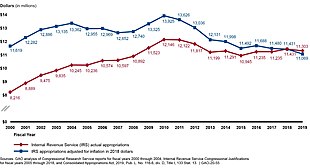
IRS appropriations, 2000–2019
Nominal appropriations
Adjusted for aggrandizement
The IRS publishes tax forms which taxpayers are required to choose from and utilise for calculating and reporting their federal tax obligations. The IRS also publishes a number of forms for its ain internal operations, such every bit Forms 3471 and 4228 (which are used during the initial processing of income tax returns).
In addition to collection of revenue and pursuing taxation cheaters, the IRS problems administrative rulings such every bit revenue rulings and private alphabetic character rulings. In addition, the Service publishes the Internal Revenue Bulletin containing the various IRS pronouncements.[63] The controlling authorisation of regulations and acquirement rulings allows taxpayers to rely on them. A letter ruling is expert for the taxpayer to whom it is issued, and gives some explanation of the Service'south position on a item revenue enhancement issue.[64] Additionally, a letter ruling reasonably relied upon by a taxpayer allows for the waiver of penalties for underpayment of tax.
Every bit is the case with all administrative pronouncements, taxpayers sometimes litigate the validity of the pronouncements, and courts sometimes make up one's mind a particular dominion to be invalid where the agency has exceeded its grant of authority. The IRS also issues formal pronouncements called Revenue Procedures, that among other things tell taxpayers how to correct prior tax errors. The IRS's own internal operations transmission is the Internal Revenue Transmission, which describes the clerical procedures for processing and auditing tax returns in excruciating item. For example, the Internal Acquirement Manual contains a special procedure for processing the tax returns of the President and Vice President of the United States.[64]
More formal rulemaking to give the Service's estimation of a statute, or when the statute itself directs that the Secretarial assistant of the Treasury shall provide, IRS undergoes the formal regulation process with a Find of proposed rulemaking (NPRM) published in the Federal Register announcing the proposed regulation, the date of the in-person hearing, and the process for interested parties to have their views heard either in person at the hearing in Washington, D.C., or by postal service. Following the statutory period provided in the Administrative Procedure Act the Service decides on the final regulations "every bit is", or every bit reflecting changes, or sometimes withdraws the proposed regulations. Generally, taxpayers may rely on proposed regulations until concluding regulations become constructive. For example, human being resources professionals are relying on the October 4, 2005 Proposed Regulations[65] (citation 70 F.R. 57930-57984)[66] for the Section 409A on deferred compensation (the so-called Enron rules on deferred compensation to add teeth to the old rules) because regulations take not been finalized.
The IRS oversaw the Homebuyer Credit and First Time Homebuyer Credit programs instituted by the federal government from 2008–2010. Those programs provided United states of america citizens with coin toward the buy of homes, regardless of income tax filings.[67]
Labor union [edit]
Most not-supervisory employees at the IRS are represented by a labor union. The exclusive labor wedlock at the IRS is the National Treasury Employees Marriage (NTEU). Employees are not required to join the union or pay dues. The IRS and NTEU have a national commonage bargaining understanding.[68]
In pursuing administrative remedies against the IRS for certain unfair or illegal personnel actions, under federal law an IRS employee may cull simply one of the 3 forums below:
- NTEU, or
- United States Merit Systems Protection Board (MSPB), or
- United States Office of Special Counsel (OSC).[69]
Employees are also required to report sure misconduct to TIGTA. Federal police force prohibits reprisal or retaliation against an employee who reports wrongdoing.[seventy] [71] [72]
Controversies [edit]
The IRS has been accused of calumniating behavior on multiple occasions.[73] [74] [75] [76] Testimony was given earlier a Senate subcommittee that focused on cases of overly aggressive IRS collection tactics in considering a need for legislation to give taxpayers greater protection in disputes with the bureau.
Congress passed the Taxpayer Neb of Rights Iii on July 22, 1998, which shifted the burden of proof from the taxpayer to the IRS in certain limited situations. The IRS retains the legal authority to enforce liens and seize assets without obtaining judgment in court.[77]
In 2002, the IRS defendant James and Pamela Moran, as well equally several others, of conspiracy, filing false tax returns and mail fraud as function of the Anderson Ark investment scheme. The Morans were somewhen acquitted, and their attorney stated that the government should have realized that the couple was merely duped past those running the scheme.[78]
In 2004, the law licenses of ii former IRS lawyers were suspended after a federal court ruled that they defrauded the courts so the IRS could win a sum in tax shelter cases.[79]
In 2013, the Internal Acquirement Service became embroiled in a political scandal in which it was discovered that the agency subjected conservative or conservative-sounding groups filing for tax-exempt status to actress scrutiny.[80]
On September v, 2014, xvi months afterwards the scandal outset erupted, a Senate Subcommittee released a report that confirmed that Internal Revenue Service used inappropriate criteria to target Tea Political party groups, but found no prove of political bias.[81] The chairman of the Senate Permanent Subcommittee on Investigations confirmed that while the actions were "inappropriate, intrusive, and burdensome", the Democrats have ofttimes experienced similar handling.[82] Republicans noted that 83% of the groups existence held up past the IRS were right-leaning; and the Subcommittee Minority staff, which did non join the Bulk staff report, filed a dissenting written report entitled, "IRS Targeting Tea Party Groups".[83]
On May 25, 2015, the agency announced that over several months criminals had accessed the private tax information of more than than 100,000 taxpayers and stolen about $fiftymillion in fraudulent returns.[84] By providing Social Security numbers and other information obtained from prior computer crimes, the criminals were able to use the IRS'southward online "Get Transcript" function to have the IRS provide them with the tax returns and other individual information of American tax filers.[85] On August 17, 2015, IRS disclosed that the breach had compromised an additional 220,000 taxpayer records.[86] On February 27, 2016, the IRS disclosed that more than 700,000 Social Security numbers and other sensitive data had been stolen.[87] [88] [89]
The Internal Revenue Service has been the subject of frequent criticism by many elected officials and candidates for political office, including some who take called to cancel the IRS. Among them were Ted Cruz, Rand Paul, Ben Carson, Mike Huckabee, and Richard Lugar.[90] In 1998, a Republican congressman introduced a bill to repeal the Internal Revenue Code by 2002.[91] In 2016, The Republican Report Committee, which counts over two-thirds of House of Representatives Republicans every bit its members, called for "the complete elimination of the IRS", and Republican Representative Rob Woodall of Georgia has introduced a pecker every year since he entered Congress in 2011 to eliminate income taxes and abolish the IRS.[92]
The IRS has been criticized for its reliance on legacy software. Systems such equally the Individual Master File are more than than l years quondam and have been identified by the Government Accountability Function as "facing significant risks due to their reliance on legacy programming languages, outdated hardware, and a shortage of human resources with critical skills".[93]
Run across also [edit]
- HM Acquirement and Customs, the UK equivalent
- Income Tax Department, India
- IRS penalties
- Tax evasion in the United States
References [edit]
- ^ "Office of Commissioner of Internal Revenue (Created past an act of Congress, July 1, 1862)". world wide web.irs.gov . Retrieved October 21, 2018.
- ^ Internal Revenue Service. "The Bureau, its Mission and Statutory Authorisation". www.irs.gov . Retrieved October 21, 2018.
- ^ "Congressional Upkeep Justification and Almanac Performance Study and Plan Fiscal Twelvemonth 2020" (PDF). Department of Treasury Internal Revenue Service. Retrieved March 3, 2022.
- ^ "Written Testimony of Commissioner Charles P. Rettig before the Business firm Appropriations Commission Subcommittee on Financial Services and General Regime on the IRS Budget and 2019 filing flavor Apr ix, 2019 | Internal Revenue Service". world wide web.irs.gov.
- ^ "Affordable Care Human activity Tax Provisions – Internal Revenue Service". world wide web.irs.gov.
- ^ "ACTC letter to Congressional-Leadership" (PDF). www.actconline.org.
- ^ "IRS Nominee Says He'southward Never Had a Client Under Audit for a Decade". Bloomberg.com. June 28, 2018. Retrieved September 19, 2020.
- ^ "1861–1865: The Ceremonious War". Tax.org. Retrieved August ix, 2010.
- ^ three U.Due south. 171 (1796).
- ^ "1866–1900: Reconstruction to the Castilian–American War". Tax.org. Archived from the original on August xiv, 2010. Retrieved August 9, 2010.
- ^ "Notes on the Amendments – The U.South. Constitution Online". USConstitution.net. Retrieved August ix, 2010.
- ^ "The starting time 1040 with instructions" (PDF) . Retrieved November 8, 2011.
- ^ "1901–1932: The Income Revenue enhancement Arrives". Taxation.org. April fourteen, 1906. Archived from the original on August 14, 2010. Retrieved August 9, 2010.
- ^ "Historical highlights of the IRS". Retrieved October 6, 2017.
- ^ Grote, JoAnn A. (2001). The Internal Acquirement Service. Infobase Publishing. p. 43. ISBN0791059898.
- ^ "IRS Historical Fact Volume: A Chronology. 1646–1992. Section of the Treasury, Internal Revenue Service" (PDF). www.governmentattic.org.
 This article incorporates text from this source, which is in the public domain .
 - ^ "Treasury Reports". world wide web.treasury.gov.
- ^ "IRS' 10 deadly sins to remain deadly". Government Executive.
- ^ "Report of the Joint Committee on Taxation Relating to the Internal Revenue Service as Required past the IRS Reform and Restructuring Act of 1998 (JCX-33-01)" (PDF). Joint Commission on Taxation. May 4, 2001. Archived from the original (PDF) on November xiii, 2018. Retrieved October 20, 2018.
- ^ "FY2014 IRS Upkeep Recommendation Special Written report" (PDF). IRS Oversight Board. May 2013. Retrieved March three, 2022.
- ^ Internal Revenue Service. "IRS Budget & Workforce". world wide web.irs.gov . Retrieved February 2, 2019.
- ^ "Investigations: Fraud in Nixon'south Taxes". Fourth dimension. November eighteen, 1974. Archived from the original on Dec 22, 2008. Retrieved May 5, 2010.
- ^ "How an IRS leak changed history altered history". Baltimore Lord's day. December 21, 2003. Archived from the original on July 11, 2012. Retrieved August ix, 2010.
- ^ "How an IRS leak changed historyaltered history". The Baltimore Dominicus. December 21, 2003. Archived from the original on January 11, 2012. Retrieved August 9, 2010.
- ^ Revenue enhancement History Projection – Presidential Revenue enhancement Returns. Taxhistory.org. Retrieved on Baronial 10, 2013.
- ^ a b Paul Cenuzi, A History of Modern Computing, MIT Press, 2003. ISBN 0262532034. pp. 119–122.
- ^ "Gratis File: Practise Your Federal Taxes for Free". Irs.gov. January 29, 2013. Retrieved February four, 2013.
- ^ Murray Dixon, Teresa (Feb 21, 2010). "As e-filing turns 20, IRS trying to win over remaining tertiary of taxpayers from paper returns". The Plainly Dealer. Cleveland. Retrieved August ix, 2010.
- ^ "IRS refunded $4 billion to identity thieves last year, inspector full general's report says". CBS News. November seven, 2013. Retrieved November ten, 2013.
- ^ a b "IRS primary warns of refund delays, poor customer service this tax year". Fox News. Jan fifteen, 2015.
- ^ Howell, Tom. "Bipartisan doubts sally on IRS ability to handle Obamacare". The Washington Times . Retrieved September 11, 2014.
- ^ The Editorial Board (January 17, 2015). "The Unsafe Erosion of Taxation". The New York Times . Retrieved March half dozen, 2017.
- ^ Course 1040, Individual Income Revenue enhancement Return for year 1918, as republished in historical documents section of Publication 1796 (Rev. Feb 2007), Internal Acquirement Service, U.Due south. Department of the Treasury. Course 1040s for years 1918, 1919, and 1920 bore the name "Internal Revenue Service". For the 1921 taxation year, the name was dropped, then was re-added for the 1929 tax year.
- ^ 1953-2 C.B. 657 (Baronial 21, 1953), filed with Division of the Federal Register on Baronial 26, 1967, 18 Fed. Reg. 5120. Compare Treas. Section Order 150-29 (July 9, 1953).
- ^ "Official web site of the National Commission on Restructuring the Internal Revenue Service". House.gov. Archived from the original on April 29, 2017. Retrieved November eight, 2011.
- ^ Pub. L. No. 105-206, 112 Stat. 685 (July 22, 1998).
- ^ IR-2010-88, Baronial four, 2010, "IRS Realigns and Renames Large Business Sectionalization, Enhances Focus on International Tax Administration", Internal Revenue Service, at IRS.gov Archived August 27, 2012, at the Wayback Machine
- ^ "U.S. Department of the Treasury, Press Release" (PDF) (Press release). September 26, 2006. Archived from the original (PDF) on November 26, 2007.
- ^ "GAO-11-308 Data Security: IRS Needs to Enhance Internal Command over Financial Reporting and Taxpayer Information" (PDF) . Retrieved Nov viii, 2011.
- ^ "The Commissioner'south Section". IRS.gov. Archived from the original on April 23, 2016. Retrieved August ten, 2017.
- ^ a b President Obama Appoints Daniel Werfel as Acting Commissioner of Internal Revenue, May 16, 2013
- ^ Zachary A. Goldfarb; Aaron Blake (May 16, 2013). "Daniel Werfel replaces Miller as acting IRS commissioner". The Washington Post . Retrieved May xvi, 2013.
- ^ a b "IRS Commissioner Says He Doesn't Want 2nd Term". Bloomberg.com. Bloomberg. April 5, 2012.
- ^ "IRS Tax Chaser Los Angeles". IRStaxreliefsettlement. Retrieved September v, 2016.
- ^ "Archived copy". Archived from the original on October 16, 2020. Retrieved August 17, 2019.
{{cite web}}: CS1 maint: archived copy as championship (link) - ^ "Function of Appeals". The states Internal Revenue Service. Retrieved July 5, 2018. This commodity incorporates text from this source, which is in the public domain .
- ^ "What Can You Expect from Appeals – Internal Acquirement Service". www.irs.gov.
- ^ "Hansberry" (PDF).
- ^ "Karen Lee Hawkins". police.ggu.edu.
- ^ "The Office of Professional person Responsibility (OPR) At-A-Glance". US Internal Revenue Service. Retrieved August 17, 2019. This article incorporates text from this source, which is in the public domain .
- ^ "Link & Larn Taxes, linking volunteers to quality e-learning". Irs.gov. Archived from the original on March 17, 2012. Retrieved December 22, 2012.
- ^ "Tax Stats at a Glance". IRS.gov. Archived from the original on May 10, 2012. Retrieved June 4, 2012.
- ^ See Table, p. 115, Upkeep of the U.Southward. Government: Fiscal Year 2011, Office of Management and Upkeep, Executive Office of the President of the United States (U.S. Gov't Printing Office, Washington, 2010), at Whitehouse.gov (PDF)
- ^ "SOI Revenue enhancement Stats – Individual Income Tax Rates and Taxation Shares". irs.gov. Archived from the original on August 6, 2012.
- ^ 'New IRS Data Reveals That the Rich Actually Do Pay Taxation – Lots of It' by John Gaver. Press Release, Actionamerica.org, October 9, 2007.
- ^ IRS Commissioner Assailed on 'Tax Gap' by Jack Speer. Morning Edition, National Public Radio, March 21, 2006.
- ^ "The Tax Gap – Internal Acquirement Service". www.irs.gov.
- ^ "Gross tax gap" (PDF) . Retrieved April 12, 2012.
- ^ U.s.a. today page 1B/2B published April 12, 2012 "complex tax code raises problems for taxpayers and IRS"
- ^ "IRS plan for individual debt collection draws criticism". The San Diego Union-Tribune. August 23, 2006. Archived from the original on June 2, 2016. Retrieved April 30, 2016.
- ^ "IRS Conducts Extensive Review, Decides Non to Renew Private Debt Collection Contracts" Archived Jan 28, 2016, at the Wayback Machine
- ^ Wheaton, Sarah (September 23, 2008). "Acorn Sues Over Video as I.R.Southward. Severs Ties". The New York Times.
- ^ "Internal Revenue Bulletin: 2012–23". Internal Revenue Service. June iv, 2012. Retrieved June 7, 2012.
- ^ a b Internal Acquirement Manual Section three.28.3.
- ^ A257.g.akamaitech.cyberspace Archived July 23, 2006, at the Wayback Automobile (PDF)
- ^ Federal Register (Book 70, Number 191) Archived Baronial 19, 2006, at the Wayback Motorcar, October 4, 2005
- ^ "First-Fourth dimension Homebuyer Credit – Internal Revenue Service". www.irs.gov.
- ^ "2019 National Understanding: Internal Acquirement Service and National Treasury Employees Union" (PDF). National Treasury Employees Wedlock. Retrieved March 3, 2022.
- ^ "Prohibited Personnel Practices (PPPs)". osc.gov. Archived from the original on July 2, 2019. Retrieved Oct 21, 2018.
- ^ "What is TIGTA". Treasury Inspector General for Revenue enhancement Administration. U.S. Department of the Treasury. Dec 11, 2014. Retrieved October 21, 2018.
- ^ "§ 2302. Prohibited personnel practices". U.S. Office of Personnel Management. Retrieved March iii, 2022.
- ^ "Department of the Treasury Employee Rules of Conduct". Federal Annals. February 19, 2016.
- ^ "Prepared Statement Of Witness Earlier The Senate Finance Committee Oversight Hearing On The Internal Acquirement Service". Archived from the original on July 29, 2007. Retrieved June 17, 2007.
- ^ Davis, Robert Edwin. "Statement before the Senate Committee on Finance". Archived from the original on Feb ix, 2007. Retrieved June 17, 2007.
- ^ Schriebman, Robert. "Prepared Argument of Robert S. Schrieman Before the Senate Finance Committee". Archived from the original on Oct 18, 2007. Retrieved June 17, 2007.
- ^ Davis, Shelley L. (September 23, 1997). "Prepared Statement of Shelley Fifty. Davis Earlier the Senate Finance Committee Oversight Hearing On The Internal Acquirement Service". Archived from the original on May 5, 2007. Retrieved June 17, 2007.
- ^ Run across 26 U.S.C. § 6331. For case police force on section 6331, see Brian five. Gugin, 853 F. Supp. 358, 94–1 U.South. Tax Cas. (CCH) paragr. l,278 (D. Idaho 1994), aff'd, 95-i U.S. Tax Cas. (CCH) paragr. 50,067 (9th Cir. 1995).
- ^ "Couple acquitted of tax fraud". The Seattle Times. January 4, 2008. Retrieved November 16, 2017.
- ^ Johnston, David Cay (August 21, 2004). "2 Ex-I.R.S. Lawyers' Licenses Suspended for Misconduct". The New York Times. ISSN 0362-4331. Retrieved November xvi, 2017.
- ^ "IRS officials in Washington were involved in targeting of conservative groups". The Washington Post . Retrieved May fifteen, 2013.
- ^ Korte, Gregory. "Senate subcommittee: No political bias in IRS targeting". USA Today . Retrieved September 10, 2014.
- ^ The Permanent Subcommittee On Investigations. "RS and TIGTA Direction Failures Related to 501(c)(four) Applicants Engaged in Campaign Activity". Retrieved September 10, 2014.
- ^ The Subcommittee Minority. "IRS Targeting Tea Political party Groups" (PDF) . Retrieved September 10, 2014.
- ^ Waddell, Kaveh (February 26, 2016). "The IRS Hack Was Twice as Bad as We Idea". The Atlantic . Retrieved November 22, 2020.
- ^ Steinberg, Joseph. "IRS Leaked Over 100,000 Taxpayers' Private Info To Criminals: What You Need". Forbes . Retrieved May 27, 2015.
- ^ Weise, Elizabeth (August 17, 2015). "IRS hack far larger than first idea". USA Today. Retrieved August 17, 2015.
- ^ "Massive IRS data breach much bigger than get-go idea". CBS News. April 18, 2016. Retrieved Apr 18, 2016.
- ^ "Hack Brief: Concluding Twelvemonth's IRS Hack Was Fashion Worse Than Nosotros Realized". Wired. ISSN 1059-1028. Retrieved November 22, 2020 – via www.wired.com.
- ^ McCoy, Kevin. "Cyber hack got admission to over 700,000 IRS accounts". U.s.a. TODAY . Retrieved Nov 22, 2020.
- ^ "A world with no IRS? Really". CNN Coin. November 4, 2015. Retrieved February xi, 2020.
- ^ "How the IRS Was Gutted". ProPublica. Dec 11, 2018. Retrieved February 11, 2020.
- ^ "Conservatives in Congress urge shutdown of IRS". Reuters. May 2, 2016. Retrieved February 11, 2020.
- ^ United States Authorities Accountability Office (June 28, 2018). IRS Needs to Take Additional Actions to Address Pregnant Risks to Tax Processing (Report). GAO-18-298.
Further reading [edit]
- Davis, Shelley L.; Matalin, Mary (1997). Unbridled Power: Inside the Undercover Culture of the IRS . New York: Harper Collins. ISBN0-88730-829-5.
- Johnston, David Cay (2003). Perfectly Legal: The Covert Campaign to Rig Our Tax Organisation to Benefit the Super Rich – and Crook Everybody Else. New York: Portfolio. ISBN1-59184-019-viii.
- Rossotti, Charles O. (2005). Many Unhappy Returns: One Man's Quest to Plough Effectually the Most Unpopular Organization in America. Cambridge: Harvard Business School Press. ISBNone-59139-441-iv.
- Roth, William V., Jr.; Nixon, William H. (1999). The Power to Destroy. New York: Atlantic Monthly Printing. ISBN0-87113-748-8.
External links [edit]
- Internal Revenue Service Official website
- Internal Acquirement Service in the Federal Annals

Source: https://en.wikipedia.org/wiki/Internal_Revenue_Service
Posted by: eppsdiesequan49.blogspot.com
0 Response to "Que Ã⩠Department Of The Treasury Internal Revenue Service Austin, Texas?"
Post a Comment